Materiality and KPI
Materiality
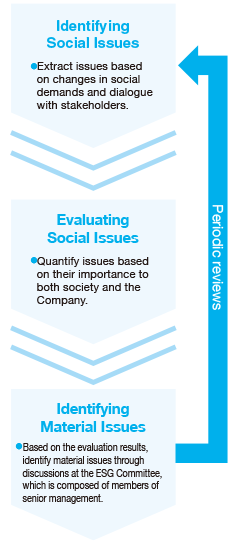
Process for Identifying Material Issues
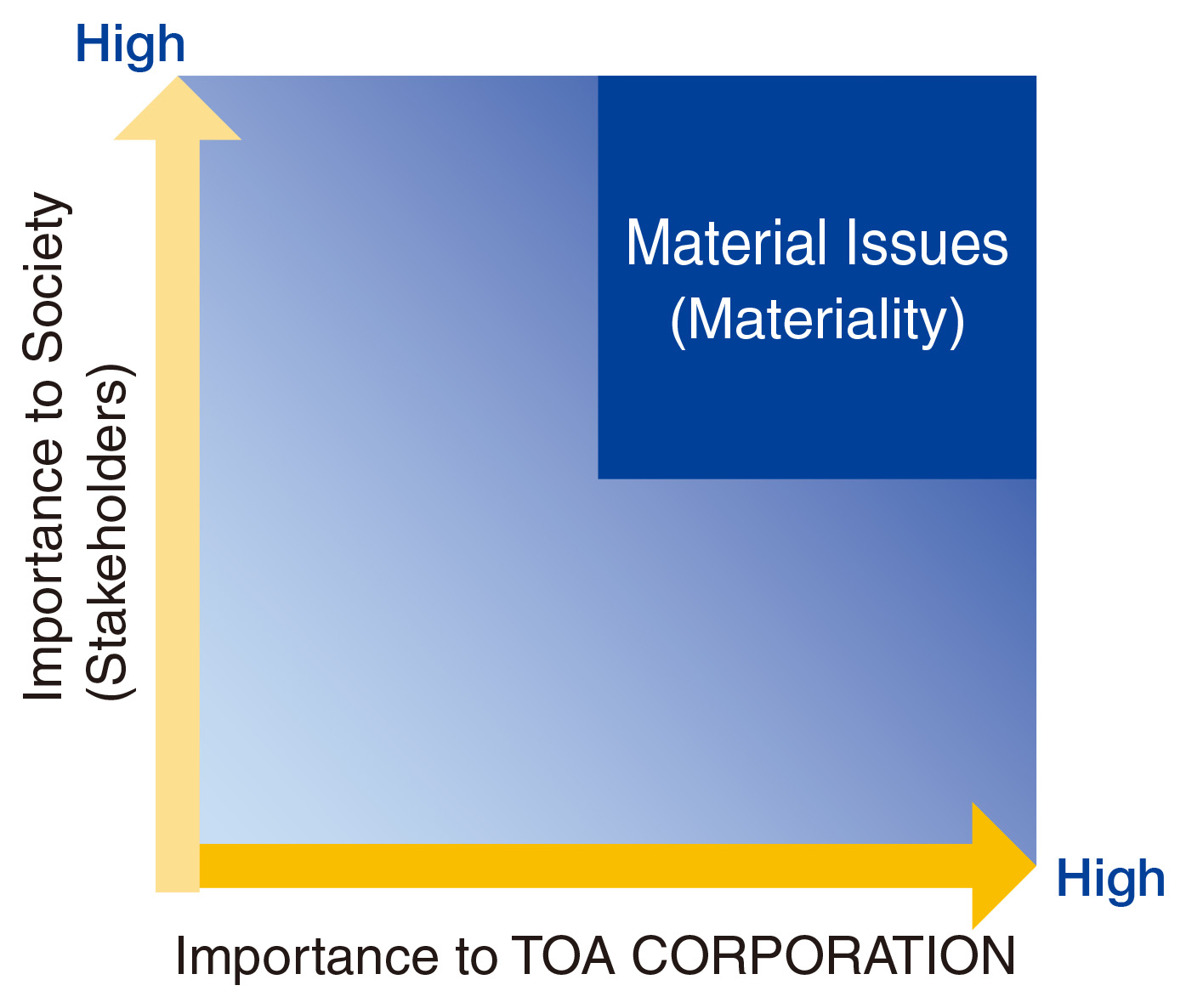
TOA CORPORATION identifies social issues by referencing international standards such as ISO 26000 and the SDGs, surveys by external ESG rating agencies, and communication with stakeholders. Among the issues considered highly important and relevant both to society (stakeholders) and to the Company, we have specified five priority items as material issues (materiality) requiring focused action. In addition, to respond to changes in risks and opportunities stemming f rom shifts in the social environment, we review our material issues once a year.
Results for FY2025 Key Performance Indicators (KPIs) and Targets
The Company has established the following key performance indicators (KPIs) and achievement targets for material ESG issues. (April 1, 2025)
| ESG | Materiality | Action plan | KPIs | FY2025 (and beyond) targets | SDGs | |
|---|---|---|---|---|---|---|
| E | Contribution to global environmental conservation | Climate Change Biodiversity |
Adopt low-carbon construction machinery, methods, and energy sources. Promote the development of decarbonization technologies. Promote the development of decarbonization technologies and technologies for the conservation and creation of biodiversity. Promote carbon neutrality through stronger collaboration with partner companies and suppliers. | Reduction rate of greenhouse gas emissions (Scope 1 and 2; compared with FY2020) | 12.5% or more |
|
| 25% or more (FY2030) | ||||||
| Virtually 100%(FY2050) | ||||||
| Reduction rate of greenhouse gas emissions (Scope 3; compared with FY2020) | 12.5% or more | |||||
| 25% or more(FY2030) | ||||||
| Building construction: Number of ZEB proposals | 5 cases or more | |||||
| Building construction: Proportion of ZEB series projects among design-build projects with a contract value of at least ¥1 billion | 50% or more | |||||
| Number of research and development projects contributing to decarbonization | 5 cases or more | |||||
|
Promoting Nature Positive |
Number of research and development projects contributing to biodiversity | 3 cases or more | ||||
|
Enhance the effectiveness of the environmental management system. |
Number of major environmental accidents | 0 cases | ||||
| Resource Circulation |
Implement reduce, reuse, and recycle (3Rs) at construction sites to promote zero emissions and resource efficiency. Promoting the Circular Economy |
Number of R&D projects contributing to the 3Rs | 3 cases or more | |||
| Final disposal rate of construction waste | 3% or less | |||||
| S | Contribution to infrastructure development through technological advancement |
Actively engage in national resilience initiatives to protect society and livelihoods from increasingly severe natural disasters. Contribute to the maintenance and renewal of aging port infrastructure, promoting the development of durable and highly sustainable infrastructure. Support infrastructure development in developing countries to improve living standards. |
Number of R&D projects contributing to disaster prevention and mitigation | 2 cases or more |

|
|
| Number of infrastructure development projects in developing countries | 3 cases or more | |||||
| Ensuring labor safety and quality |
Promote the advancement of construction and management practices through the use of Information and Communication Technology (ICT) and new technologies. Enhance the effectiveness of the quality management system. Strengthen efforts to prevent nonconforming products through collaboration between the Domestic Civil Engineering Business Unit and Building Construction Business Unit and the International General Headquarters. |
Number of quality nonconformance cases with losses of ¥5 million or more (Domestic Civil Engineering) | 3 cases or fewer | |||
| Number of quality nonconformance cases resulting in losses of ¥5 million or more (Domestic Building Construction) | 3 cases or fewer | |||||
| Number of quality nonconformance cases resulting in losses of ¥10 million or more (Overseas) | 3 cases or fewer | |||||
|
Ensure accurate understanding of construction specifications and customer requirements, align site and management teams on these standards, and deliver high-quality outcomes that meet client expectations. After project completion, collect and analyze customer feedback and provide insights for application in subsequent projects. Utilize BIM as a platform in the Digital Transformation Production Design Section to enhance productivity. |
Customer satisfaction rating (government agencies, internal indicators) | 80 points or more | ||||
| Customer satisfaction rating (private sector, internal indicators) | B or above | |||||
| Customer satisfaction survey response rate | 90% or more | |||||
|
Improve the effectiveness of the Occupational Safety and Health Management System. Eliminate occupational and public accidents by prioritizing safety above all else. |
Number of serious accidents | 0 cases | ||||
| Number of serious public accidents | 0 cases | |||||
| Accident frequency rate (absence of 4 days or more, domestic) | 0.70 or less | |||||
| Lost workday frequency rate (4+ days lost, overseas) | 0.20 or less | |||||
| Developing diverse human resources and promoting active engagement |
To achieve diversity and inclusion, the Human Resources Strategy Section will lead efforts to formulate concrete measures and promote a change in mindset. Secure and develop a diverse range of human resources based on the Basic Policy for Human Resource Development. Each business unit will be responsible for recruiting personnel and developing the necessary training curricula. Promote DX to nurture highly skilled talent, enhance basic skills, and contribute to improved productivity and new work styles, ultimately positioning the company as one that contributes to society. Enhance employee benefits and education while further promoting work-style reform through operational improvements. Collaborate with partner companies, both domestically and overseas, to foster understanding and mitigate human rights risks across the entire supply chain. Promote a transparent and open organization by encouraging employees to proactively communicate and implement their ideas through the employee suggestion system. |
Employment rate for persons with disabilities | 2.5% or more | |||
Number of female employees in career-track positions*1
| 250 persons or more(FY2030) |
| |||||
| Number of foreign national employees in career-track positions | 40 persons or more (FY2030) | |||||
| Number of female employees in semi-executive and executive positions | 30 persons or more(FY2030) | |||||
| Number of foreign national employees in semi-executive and executive positions | 10 persons or more (FY2030) | |||||
| Number of research and development projects contributing to productivity improvement | 6 cases or more | |||||
| Average score of the 28 items related to employee satisfaction in the company-wide compliance awareness survey | Exceeding the previous fiscal year’s score | |||||
| G | Strengthening compliance and governance |
Establish a corporate governance framework to enhance corporate value. management plan period 1 time Maintain and enhance the effectiveness of internal controls across the TOA CORPORATION Group to prevent recurrence of misconduct. |
Frequency of third-party board effectiveness assessments | Once during the medium-term management plan period |

|
|
| Frequency of governance monitoring for domestic consolidated subsidiaries*2 | Annually for each subsidiary | |||||
|
Recognize potential risks and take all necessary measures to prevent them, while responding effectively if they occur. Strengthen business continuity management (BCM). Implement robust information security management practices. |
Number of serious information security incidents | 0 cases | ||||
| Number of company-wide BCP drills conducted | Annually | |||||
| 24-hour response rate in safety confirmation training | 100% | |||||
|
Enhance and reinforce compliance education. Prevent a decline in employee awareness of construction quality issues. |
Number of serious violations of laws and regulations | 0 cases | ||||
| e-learning participation rate for compliance*3 | 100% | |||||
| Average scores of 18 items related to compliance in the company-wide compliance awareness survey | Exceeding the previous fiscal year’s score | |||||
E
Contribution to global environmental conservation
- Action plan
- Climate Change Biodiversity
Adopt low-carbon construction machinery, methods, and energy sources.
Promote the development of decarbonization technologies.
Promote the development of decarbonization technologies and technologies
for the conservation and creation of biodiversity.Promote carbon neutrality through stronger collaboration with partner
companies and suppliers.Promoting Nature Positive
Enhance the effectiveness of the environmental management system.
- KPIs
- Climate Change Biodiversity
- FY2025 (and beyond) targets
- 12.5% or more
- 25% or more(FY2030)
- Virtually 100%(FY2050)
- KPIs
- Reduction rate of greenhouse gas emissions (Scope 3; compared with FY2020)
- FY2025 (and beyond) targets
- 12.5% or more
- 25% or more(FY2030)
- KPIs
- Building construction: Number of ZEB proposals
- FY2025 (and beyond) targets
- 5 cases or more
- KPIs
- Building construction: Proportion of ZEB series projects among design-build projects with a contract value of at least ¥1 billion
- FY2025 (and beyond) targets
- 50% or more
- KPIs
- Number of research and development projects contributing to decarbonization
- FY2025 (and beyond) targets
- 5 cases or more
- KPIs
- Number of research and development projects contributing to biodiversity
- FY2025 (and beyond) targets
- 3 cases or more
- KPIs
- Number of major environmental accidents
- FY2025 (and beyond) targets
- 0 cases
- Action plan
- Resource Circulation
-
Implement reduce, reuse, and recycle (3Rs) at construction sites to promote zero emissions and resource efficiency.
Promoting the Circular Economy
- KPIs
- Number of R&D projects contributing to the 3Rs
- FY2025 (and beyond) targets
- 3 cases or more
- KPIs
- Final disposal rate of construction waste
- FY2025 (and beyond) targets
- 3% or less
S
Contribution to infrastructure development through technological advancement
- Action plan
-
Actively engage in national resilience initiatives to protect society and livelihoods from increasingly severe natural disasters. Contribute to the maintenance and renewal of aging port infrastructure, promoting the development of durable and highly sustainable infrastructure.
Support infrastructure development in developing countries to improve living standards.
- KPIs
- Number of R&D projects contributing to disaster prevention and mitigation
- FY2025 (and beyond) targets
- 2 cases or more
- KPIs
- Number of infrastructure development projects in developing countries
- FY2025 (and beyond) targets
- 3 cases or more
Ensuring labor safety and quality
- Action plan
-
Promote the advancement of construction and management practices through the use of Information and Communication Technology (ICT) and new technologies.
Enhance the effectiveness of the quality management system.
Strengthen efforts to prevent nonconforming products through collaboration between the Domestic Civil Engineering Business Unit and Building Construction Business Unit and the International General Headquarters.
- KPIs
- Number of quality nonconformance cases with losses of ¥5 million or more (Domestic Civil Engineering)
- FY2025 (and beyond) targets
- 3 cases or fewer
- KPIs
- Number of quality nonconformance cases resulting in losses of ¥5 million or more (Domestic Building Construction)
- FY2025 (and beyond) targets
- 3 cases or fewer
- KPIs
- Number of quality nonconformance cases resulting in losses of ¥10 million or more (Overseas)
- FY2025 (and beyond) targets
- 3 cases or fewer
- Action plan
-
Ensure accurate understanding of construction specifications and customer requirements, align site and management teams on these standards, and deliver high-quality outcomes that meet client expectations.
After project completion, collect and analyze customer feedback and provide insights for application in subsequent projects.
Utilize BIM as a platform in the Digital Transformation Production Design Section to enhance productivity.
- KPIs
- Customer satisfaction rating (government agencies, internal indicators)
- FY2025 (and beyond) targets
- 80 points or more
- KPIs
- Customer satisfaction rating (private sector, internal indicators)
- FY2025 (and beyond) targets
- B or above
- KPIs
- Customer satisfaction survey response rate
- FY2025 (and beyond) targets
- 90% or more
- Action plan
-
Improve the effectiveness of the Occupational Safety and Health Management System.
Eliminate occupational and public accidents by prioritizing safety above all else.
- KPIs
- Number of serious accidents
- FY2025 (and beyond) targets
- 0 cases
- KPIs
- Number of serious public accidents
- FY2025 (and beyond) targets
- 0 cases
- KPIs
- Accident frequency rate (absence of 4 days or more, domestic)
- FY2025 (and beyond) targets
- 0.70 or less
- KPIs
- Lost workday frequency rate (4+ days lost, overseas)
- FY2025 (and beyond) targets
- 0.20 or less
Developing diverse human resources and promoting active engagement
- Action plan
-
To achieve diversity and inclusion, the Human Resources Strategy Section will lead efforts to formulate concrete measures and promote a change in mindset.
Secure and develop a diverse range of human resources based on the Basic Policy for Human Resource Development.
Each business unit will be responsible for recruiting personnel and developing the necessary training curricula.
Promote DX to nurture highly skilled talent, enhance basic skills, and contribute to improved productivity and new work styles, ultimately positioning the company as one that contributes to society.
Enhance employee benefits and education while further promoting work-style reform through operational improvements.
Collaborate with partner companies, both domestically and overseas, to foster understanding and mitigate human rights risks across the entire supply chain.
Promote a transparent and open organization by encouraging employees to proactively communicate and implement their ideas through the employee suggestion system.
- KPIs
- Employment rate for persons with disabilities
- FY2025 (and beyond) targets
- 2.5% or more
- KPIs
- Number of female employees in career-track positions*1
- FY2025 (and beyond) targets
- 250 persons or more (FY2030)
- KPIs
- Number of foreign national employees in career-track positions
- FY2025 (and beyond) targets
- 40 persons or more(FY2030)
- KPIs
- Number of female employees in semi-executive and executive positions
- FY2025 (and beyond) targets
- 30 persons or more(FY2030)
- KPIs
- Number of foreign national employees in semi-executive and executive positions
- FY2025 (and beyond) targets
- 10 persons or more(FY2030)
- KPIs
- Number of research and development projects contributing to productivity improvement
- FY2025 (and beyond) targets
- 6 cases or more
- KPIs
- Average score of the 28 items related to employee satisfaction in the company-wide compliance awareness survey
- FY2025 (and beyond) targets
- Exceeding the previous fiscal year’s score
G
Strengthening compliance and governance
- Action plan
-
Establish a corporate governance framework to enhance corporate value. management plan period 1 time
Maintain and enhance the effectiveness of internal controls across the TOA CORPORATION Group to prevent recurrence of misconduct.
- KPIs
- Frequency of third-party board effectiveness assessments
- FY2025 (and beyond) targets
- Once during the medium-term management plan period
- KPIs
- Frequency of governance monitoring for domestic consolidated subsidiaries*2
- FY2025 (and beyond) targets
- Annually for each subsidiary
Strengthening compliance and governance
- Action plan
-
Recognize potential risks and take all necessary measures to prevent them, while responding effectively if they occur.
Strengthen business continuity management (BCM).
Implement robust information security management practices.
- KPIs
- Number of serious information security incidents
- FY2025 (and beyond) targets
- 0 cases
- KPIs
- Number of company-wide BCP drills conducted
- FY2025 (and beyond) targets
- Annually
- KPIs
- 24-hour response rate in safety confirmation training
- FY2025 (and beyond) targets
- 100%
Strengthening compliance and governance
- Action plan
-
Enhance and reinforce compliance education.
Prevent a decline in employee awareness of construction quality issues.
- KPIs
- Number of serious violations of laws and regulations
- FY2025 (and beyond) targets
- 0 cases
- KPIs
- e-learning participation rate for compliance*3
- FY2025 (and beyond) targets
- 100%
- KPIs
- Average scores of 18 items related to compliance in the company-wide compliance awareness survey
- FY2025 (and beyond) targets
- Exceeding the previous fiscal year’s score
- *1 Includes area-limited career-track employees.
- *2 For consolidated subsidiaries with branch offices, separate branch monitoring is conducted once per year.
- *3 Includes domestic consolidated subsidiaries.